
When Rotom first appeared in Pokémon Diamond and Pearl, it hardly felt like an ordinary encounter. Hidden inside the eerie Old Chateau, it would burst out of a television late at night, triggering a battle set to the same dramatic theme used for Legendary Pokémon. With only one chance to catch it per save file, many players naturally assumed Rotom belonged among Sinnoh’s Legendaries.
Fast forward to recent games, and Rotom’s status has changed dramatically. What was once a mysterious, one-time encounter can now be found multiple times in the wild—and in Pokémon Legends: Z-A, Rotom are so common that they power everyday devices like smartphones. This shift raises an interesting question: was Rotom ever truly meant to be a Legendary Pokémon?
Why Rotom Once Seemed Legendary

There’s a strong case that Rotom was originally designed with Legendary-like qualities. In Diamond and Pearl and their remakes, players needed the National Pokédex and had to visit the Old Chateau at night to trigger its encounter. The presentation—complete with unique conditions, eerie atmosphere, and Legendary battle music—mirrored that of Pokémon like Heatran and Cresselia.
Pokémon Platinum reinforced this impression by introducing Rotom’s alternate appliance forms. At the time, form changes were rare and typically reserved for special Pokémon. Aside from Castform and Burmy, most Pokémon with alternate forms were Legendary or Mythical, such as Giratina and Shaymin. Giving Rotom multiple forms seemed to elevate its status further.
Despite all this, Rotom still stood apart from true Legendaries in subtle but important ways.
What Set Rotom Apart
Stat-wise, Rotom didn’t quite measure up. Its base form had a total of 440—far below most Legendaries. Even with its appliance forms boosting it to 520, it remained underwhelming compared to many Mythical Pokémon.
Breeding mechanics also worked against its Legendary image. Rotom can breed with Ditto and produce more Rotom eggs, something almost no Legendary Pokémon can do. While Manaphy is a rare exception, it only produces Phione eggs—not more Manaphy—making Rotom’s case very different.
Its catch rate added to the inconsistency. With a catch rate of 45, Rotom was significantly easier to capture than most Legendaries, which often have much lower rates. While some Mythicals share this catch rate, those are typically limited-time encounters—something Rotom never was.
The Turning Point
Rotom’s transition away from Legendary status became more obvious in later generations. In Pokémon Black and White, players could still only obtain one Rotom, but this time through an in-game trade rather than a special encounter.
The real shift came in Pokémon X and Y, where Rotom became a repeatable wild encounter in the Lost Hotel. The unique music and one-time mystique were gone, and players could catch as many Rotom as they wanted. From that point on, it was clear: Rotom was no longer treated as anything close to a Legendary.
Why Rotom Became Common
Several factors likely contributed to this change. Its relatively low stats and ability to breed made it difficult to justify as a Legendary Pokémon. Additionally, Rotom lacked the grand, mythological backstory that defines most Legendaries. While Sinnoh’s Legendary Pokémon are tied to creation myths, time, space, and nature, Rotom’s origins are comparatively mundane—essentially a mischievous spirit inhabiting appliances.
Even its small bits of lore, such as connections hinted at in Platinum, don’t elevate it to the same level as Pokémon like Arceus or Dialga.
A New Role in the Pokémon World
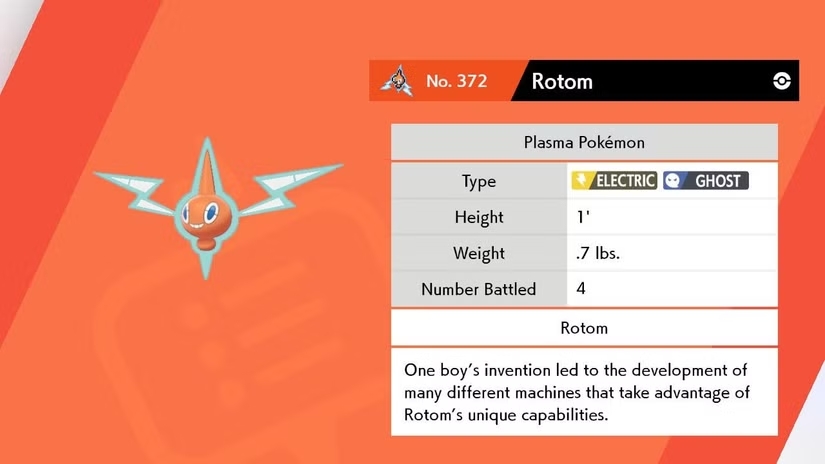
Rather than fading into obscurity, Rotom found a new purpose. Starting in Generation 7, it became a key part of the Pokémon world’s technology. The Rotom Pokédex in Sun and Moon introduced players to a talking, personality-driven device.
In Generation 8, this idea expanded even further. Rotom began powering everyday technology—phones, bikes, PCs, and more—making it an integral part of daily life in the Pokémon universe.
By Generation 9, Rotom-powered smartphones had become standard equipment for trainers, even featuring practical functions like cushioning falls. In Pokémon Legends: Z-A, these devices are deeply integrated into gameplay, including platforming mechanics.
Why This Change Was for the Best
For longtime fans, Rotom’s shift from mysterious encounter to common utility Pokémon might feel like a downgrade. However, this evolution arguably made Rotom more relevant than ever.
Allowing players to encounter multiple Rotom opens up more gameplay possibilities, from experimenting with its different forms to including it on a main story team. It’s no longer locked behind post-game content or one-time events.
From a lore perspective, Rotom’s widespread use makes perfect sense. In a world where Pokémon can generate energy safely, it’s only natural that humans would integrate them into everyday technology. This shift enhances the world-building of the series, showing how closely Pokémon and people coexist.
In the end, Rotom may have lost its Legendary mystique—but it gained something far more valuable: a lasting role in the Pokémon world.
Visit our website MMOWOW to get Pokemon Legends Z-A items at the cheapest rate on the web. We offer quick delivery, safe payments, and 24x7 chat support.